
God Finding Themselves
Iron and Wine's "Such Great Heights" (The Postal Service cover)

Alright, I’m honestly not sure which will be more controversial:
that I used "they/them” pronouns for God
that I prefer Iron and Wine’s version of “Such Great Heights” over the Postal Service original
But what can I say? Jimmy Tamborello smothered the original under cheap electronic drums.1 We tend to prefer the version we heard first, and Iron and Wine found me vulnerable and in desperate need of its beauty: my year in Germany.
Beer and Bread Land – Busch Gardens the Continent – where everything was too small for a corn-fed American such as meself.
See, “Moving to Germany” had squatted in my brain for years, sedate and ignorable, until one day it stormed the cockpit and flew me there. ‘So much in the natural world exists only as potential.’ The squatter assured me, poking me on the chest as my hijacked life crossed the Atlantic. ‘Without controlled heat and alloying elements, iron ore never becomes steel.’ It said, plunging a syringe into my ego and watching it slump on the pilot’s seat. ‘So much exists in YOU only as tiny-little-iron-ore lumps, and YOU should change that.’
My first night, I slept above the “Fetisch und Erotikladen.”
I shuffled the streets like a squawking dodo: something only pity could keep from extinction. [Okay, I’m referencing my own poem, sue me]. My only friends were my horny Malaysian landlord and my Taiwanese roommate, who spricht kein Englisch. Before I could even offer my travels as a fragrant sacrifice to The Gram, I had to settle my existence with Germany’s Ausländerbehörde (the immigration bureau) and became a Kafka fan overnight.

I experienced poverty for the first time (not just the romantic poverty of undergrad), and like a London street-urchin, I mouth-breathed outside H&M, snowflakes in my hair. I Grinched among Who-ville and their endless Weihnachtsmärkte (Christmas markets), filled with pork-buns and cauldrons of wine. I cursed my pockets as I passed the Kebab house and some busker played a decrepit, off-key version of "Blowin' in the Wind" beside his empty guitar case.
It was around this time that I REALLY dug into my iPod library. [If it isn’t clear already, the iPod for me is like typewriters and coffee pots to the Beats].
“Such Great Heights” – with its longing for a distant other, its commentary on idealization at a distance, its condemnation of technology’s ability to replicate true contact – hit me square between my immigrant eyes.

A generation encountered The Postal Service and Death Cab for Cutie during their peak teen or pre-teen years, and despite missing that boat, my German time really felt like being 19 again, in all the best and worst ways.2
Becoming an adult, I froze so much of myself just to function, but living overseas did nothing but thaw my longings. For romance. For God. For the train roof to peel back, and something to show its face.
American Christianity does not speak much of romance and romantic yearning. Outside of clunkers like “heaven meets earth like a sloppy wet kiss” – and the are-they-talking-about-Jesus-or-a-girl trope, which I might call “hot for Jesus”3 – Christians tend to divinize agape and denigrate eros. Agape is God; eros is, well, eros is some freaky shit.
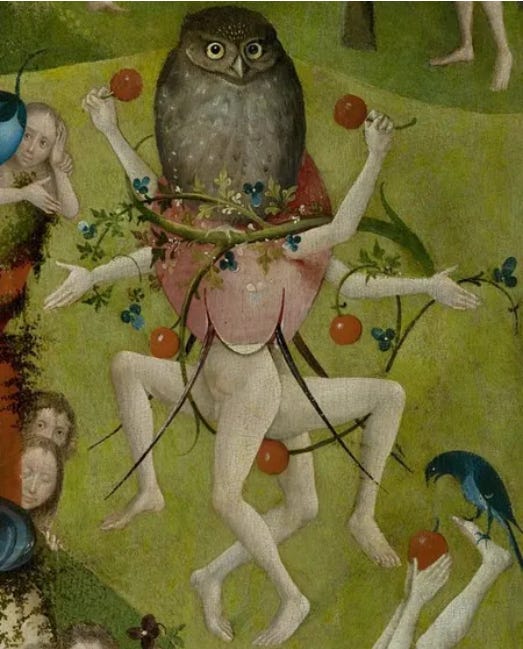
And it’s true; gone awry, eros stirs us to nothing less than homicide and death. Yet Church fathers no less luminous than Gregory of Nyssa spoke of a divine eros: of the soul’s yearning for unification with the One. Eros, according to the neo-platonic tradition, pushes the soul beyond intellect and out to infinite beauty and goodness.
I guess I’m saying – Erotica just ain’t what it used to be.
But we can still find erotic tatters in songs like “Such Great Heights:” where human yearning points to the divine, even in our post-belief age. I want to discuss this longing today: how the Christian world has neglected it – and for that matter, the divine feminine – to its detriment.
The Song, “Such Great Heights”
I am thinking it's a sign
That the freckles in our eyes
Are mirror images
And when we kiss, they're perfectly aligned
And I have to speculate
That God himself did make
Us into corresponding shapes
Like puzzle pieces from the clay- The Postal Service, Such Great Heights
Having spent my tender Sunday mornings in front of a flannelgraph, I can’t possibly hear “puzzle pieces from the clay” without my hound-dog-ears sticking way-the-fuck-up – especially when couched in such gorgeous sentiment.
But you don’t need to drain your skull cavity of cerebrospinal fluid and replace it with the Bible to recognize Eden when you hear it: that story where the deity play-doughs a golem for his garden, finds it alone, and to ameliorate the situation, knocks him out and play-doughs a creature’s helper. Much preferable to the Egyptian creation myth, where Atum the divine spluges out humans during a primordial wank.

Of course, to find the creature’s helper, Gibbard doesn’t mention how Yahweh fumbles through creating every possible animal to get there,4 nor how the man determined the animals unfit. [But considering the story is about finding a wife, we can only speculate . . .].5
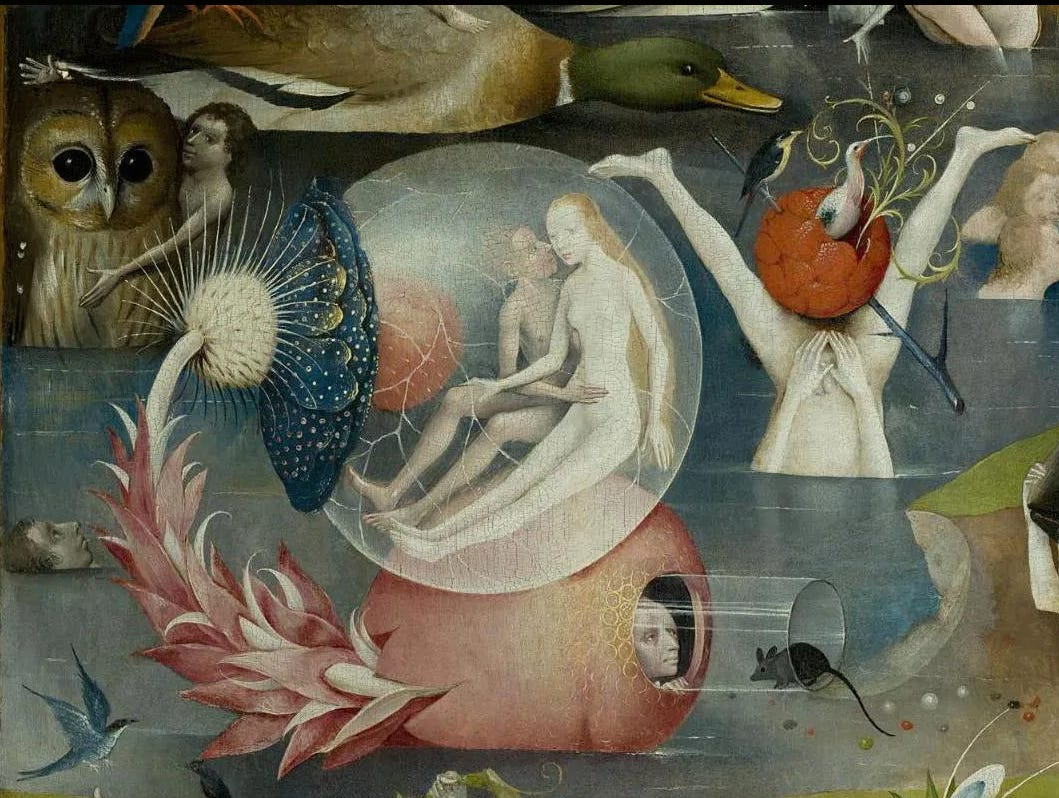
But procedure aside, Adam ends up with the only possible being for him: an equal who fits like a puzzle. And puzzles don’t just click together; they create a beautiful picture. Anyone in love could grant Ben Gibbard’s musings about romantic fate, even if, like him, they immediately doubt it – or like me, talk flippantly about it.
And true, it may seem like a stretch
But it's thoughts like this that catch
My troubled head when you're away
When I am missing you to death
For the sober, matching nevi are not autographs pointing to a divine order, but the court of love has always held a different standard of evidence. Eros doesn’t just rocket us into the divine; it turns us into junkies combing the carpet for chalk, scouring our lives for heaven’s scraps.

I mean, I get it. Like Ben, my longings are Adam-shaped. [Not “Atum-shaped” :P]. And if Gibbard and his partner cast themselves as Adam and Eve – from their great heights of deluded fancy – then they aren’t just “made for each other” as corresponding shapes, they’re feeling emotions no one has ever felt. They’re originals.
And doesn’t love make us all feel original?6
Personally though, I prefer Aristophanes’ version in Plato’s symposium, despite what can only be described as its body horror.
Unlike the Genesis myth, Aristophanes describes “circle people” who were once joined together but cleaved by a fretful Zeus because, idk, they could scurry fast or some shit. [Seriously, this design does not seem optimal, let alone a threat to the divine order!].
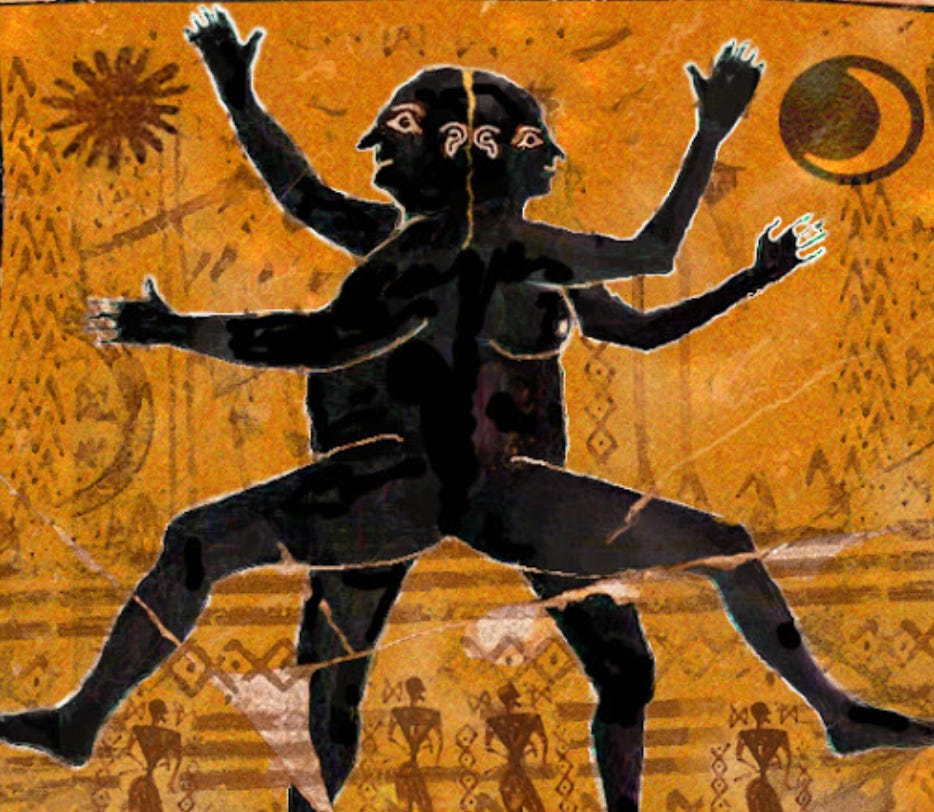
The “great heights” (that Ben and his partner wave from) reflect Zeus’s Tower-of-Babel-like fear of human romantic unity, which Aristophanes called “their ascent to heaven,” and which Ben’s peers actively dissuade.
They will see us waving from such great heights
"Come down now," they'll say
But everything looks perfect from far away
"Come down now," but we'll stay
If you’re not in love – love is terrifying. Madness. Barking at the moon from the top of a tree.
If you’re in love – it will melt you down, and you’ll never be the same. But you’ll find this so sublime, you’ll seek it at all costs.
So, where Eden falls silent, Aristophanes enriches our vocabulary of human longing. Separated, the two circle-halves forever seek each other – and the wholeness they originally had in each other. Could Adam, who had Eve custom-created the moment he felt a slight twinge of loneliness, possibly understand that longing? [A longing much better conveyed in the Iron and Wine cover ^_^].
Then again, the DAMN flannelgraph may have duped me, as the actual Hebrew reflects a division not unlike Aristophanes: with Genesis referring to the first human as “Ha’adam” (the same word applying to general humanity in Genesis 1:27) and only naming the male/husband “Ish” and female/wife “Ishshah” after Yahweh chopped that ass in half, like Obi-wan Kenobi.

So, we’re left with nuance.7 My favorite!
Both stories represent love as unification, with man and wife becoming “one flesh” in Genesis after separation. And when reunited, the circle people – who sting with exile from each other, rather than paradise – gain powers that make the gods tremble.
I love that Aristophanes acknowledges men/men and women/women pairings in his origin story [although with cultural baggage], but the Biblical account dignifies humanity far more substantially8 – although dignity of course might not be truth – with both men and women being in the image of God (vs. something Zeus keeps around to people his fulfillment center).9
It’s for this reason that I called God “they.” Well, reasons.
Both male and female are in the divine image
The trinity is a plurality, and a unity, but still a plurality [consider the grammatical intelligibility of “they communed together,” referring to the father, son, and holy ghost]
The church (a collective noun) is the bride of Christ, and the bride becomes “one flesh” with the groom (with somewhat disturbing implications there – but hey, I didn’t invent the metaphor)
But what about “God finding themselves?”
Well, that’s a little more complicated, but I believe we’re all part of God; that we came from God and will return to God – and that our lives, in the meantime, prepare us for God. The “bride of Christ,” after all, reflects original unity: with the "Ishshah” taken out of “Ha’adam” and later reunited with “Ish.”
Our lives, if they’re anything, are stories of separation. From the animal world. From the Good. From God. On the cross, even Christ intimates this separation of God from God. And when he descends into death and hell (WHERE TRADITION HOLDS, GOD IS NOT), he finalizes it. But in finalizing the separation only destroys it.
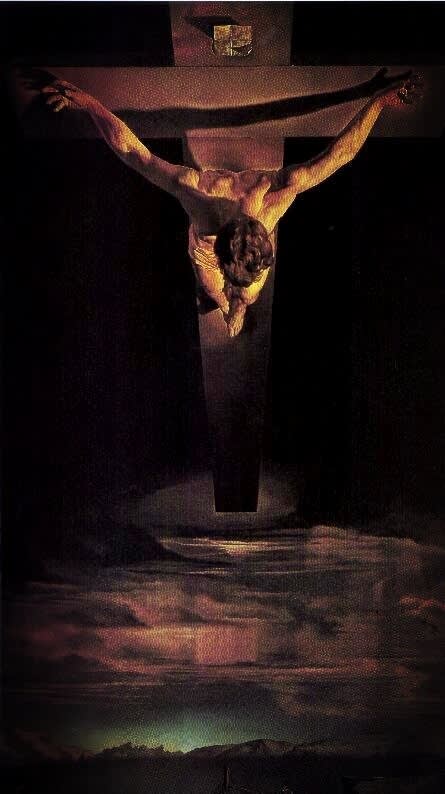
This is the myth of Christianity.
Maybe it’s true, maybe not.
Perhaps it’s true in heaven only.
Perhaps we must make it true.
But we’re left with our yearnings. Some for a divine masculine, some for a divine feminine, some for the ground of being that births all things. We see these in each other, and the glimpse drives us to great, mystic heights. And while this is pure speculation, I believe that we can find a divine masculine in church, but not a divine feminine (whereas various pagan strands can). Perhaps this has affected not just church attendance, but the character of worship itself.
Yeats demonstrates this longing well in the Song of Wandering Aengus:
I went out to the hazel wood,
Because a fire was in my head,
And cut and peeled a hazel wand,
And hooked a berry to a thread;
And when white moths were on the wing,
And moth-like stars were flickering out,
I dropped the berry in a stream
And caught a little silver trout.When I had laid it on the floor
I went to blow the fire a-flame,
But something rustled on the floor,
And someone called me by my name:
It had become a glimmering girl
With apple blossom in her hair
Who called me by my name and ran
And faded through the brightening air.Though I am old with wandering
Through hollow lands and hilly lands,
I will find out where she has gone,
And kiss her lips and take her hands;
And walk among long dappled grass,
And pluck till time and tides are done,
The silver apples of the moon,
The golden apples of the sun.
This glimpse of the divine sent Yeats on a lifelong search that human love imitates and can never completely fill. In “Such Great Heights,” we see this longing for distant love transmuted into art: an experience evident on any radio station.
I tried my best to leave
This all on your machine
But the persistent beat
It sounded thin upon the sendingAnd that frankly will not fly
You’ll hear the shrillest highs
And lowest lows with the windows down
And this is guiding you home
Eros crosses – and destroys – distances. It cannot abide them. Eros aims for union. It makes us write quirky songs and blast our passion across the globe. It sends us back to each other, even if the song grows thin and the middle blasts out.
So, Agape is God – a love that passes selfishness and personal gain.
But Eros is God – the force that inspires us to seek, to create, and to change.
In a healthy, romantic love, we find a life-giving, life-generating wholeness that models how one might approach the divine. Granted, most of us do not have the spiritual sophistication of Rumi [a Sufi poet and mystic whose writing can only be discussed with enthusiasm]; the worship-romance wires get a bit crossed there.

But romance is atonement (at-one-ment) in miniature, if one can endure its crucible. Those “great heights” bring danger and ecstasy alike.
So – we should not freight romantic love with all our hopes for meaning and purpose and happiness. Life is not a romcom. Meet cute is not “meet my only reason for being.” But we shouldn’t make the opposite mistake either: of assuming that eros – and the romance that embodies it – has nothing to do with divinity.
Where else but God’s image should one find God? And where else but romance does that image shine clearest?
In Germany, I told a musician friend about the Postal Service, impressing him with the whole music-made-from-mailing-recordings-back-and-forth thing. Then he heard Such Great Heights, and his response was, “oh.”
LCD Soundsystem: “Sound of silver, talk to me
Makes you want to feel like a teenager
Until you remember the feelings of
A real-life emotional teenager
Then you think again”
Which, take it from a guy who writes a music theology blog, is fucking everywhere.
Or, if we get more advanced, the full-on love songs of someone like John Donne or Sufjan Stevens, where that distinction grows artful and watery.
This for me is a personal Mandela effect. I never remember anyone in church mentioning that Yahweh forms ALL the animals from the ground, just the human.
The entire Genesis 2 creation story (the J source) is set up to explain why man and woman go together, after all, with Genesis 2:24 culminating in the “that is why man leaves his father . . .”
*Flips hair over eye. ‘No one has suffered like I’ve suffered!’
Odd though that Ha’Adam’s loneliness could be cured with division within themselves. There’s a curious ancient logic at work there.
Taking the two Genesis creation accounts together muddles things slightly. Ha’adam is in the image of God in Genesis 1, but Genesis 2 alone leaves a vaguer impression. Then again, whoever compiled them did not seem to think the two accounts needed further redaction.
So many ancient myths amount to: “we need these humans to milk their sacrifices/worship.” Granted, one could read Adam and Eve “tending the garden” in a similar way if you felt inclined.